Home Systems Components Galleries Store Blog

'Audio Note'

Audio Note at CES 2012

Saturday, December 31st, 2011 by Mike

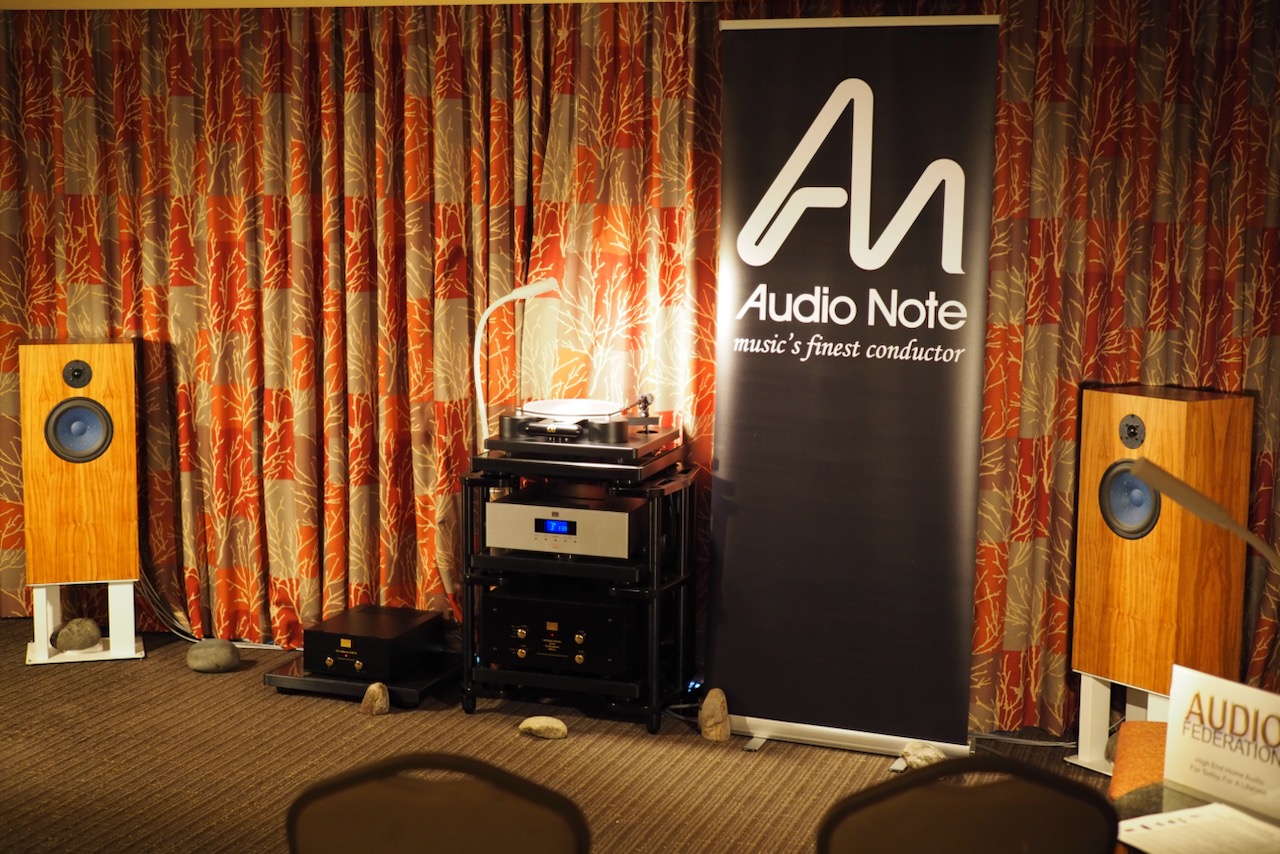
Although there will not be a dedicated Audio Note UK room this year at CES/THE SHOW, Audio Note equipment will be featured in two rooms at the Venetian.

Venetian room 29-327 - Robert Lighton Audio

Robert Lighton Audio will be showcasing their new RL10 95db efficient speakers along with:

Audio Note Meishu Silver Signature (9 watt Class A single-ended 300B line only integrated amplifier)
Audio Note M3 RIAA Phono Stage
Audio Note TT3 0.5 Reference turntable and/or Thorens turntable
Audio Note CD 4.1x CD Player

Robert is a long time fan/supporter of Audio Note gear, and these speakers are designed from the get-go to run off of low-powered tube equipment like Audio Note amplifiers. Should be very interesting.

Venetian Room 29-230 - Volent Audio

Volent Corporation will be showcasing their VL-3 speakers along with:

Audio Note Jinro (25 watt 211 SE integrated amplifier - $24,000 copper version of the Ongaku)

We’ve heard rumors that Volent speakers work well with the smaller 300B Audio Note UK amps - and, if so, they should, in all likelihood, kick butt on the Jinro integrated amp. Should also be an interesting room.

RMAF 2011 - Inexpensive Audio Note Room

Wednesday, October 19th, 2011 by Mike


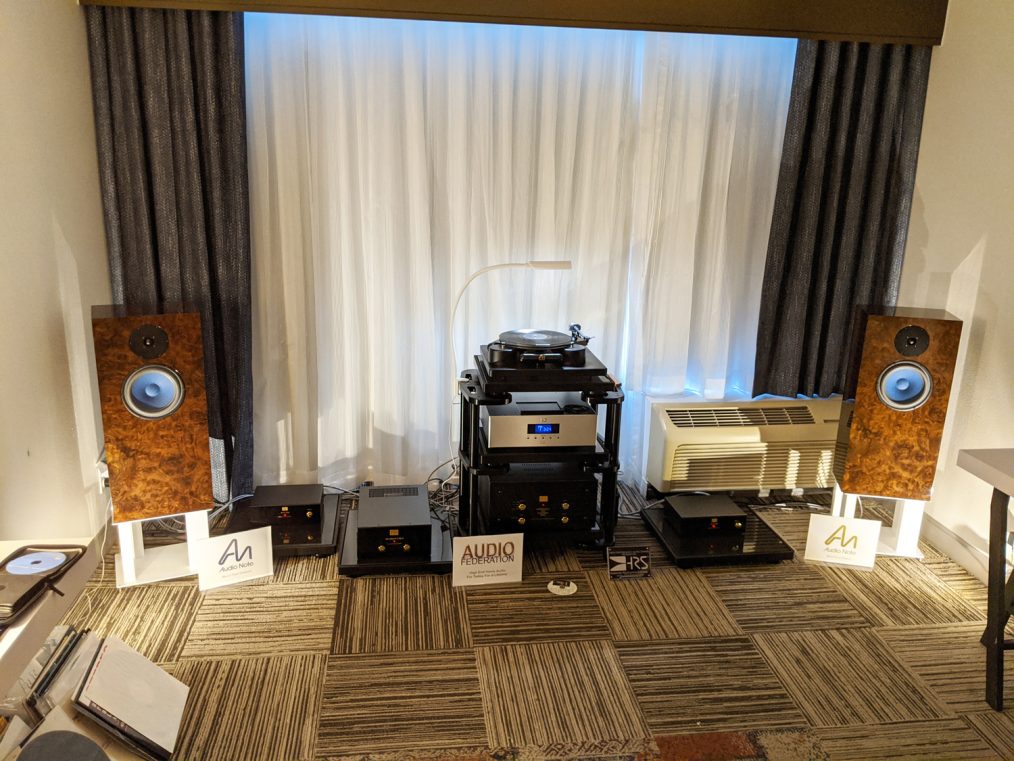
This was about a $25K system including cables.


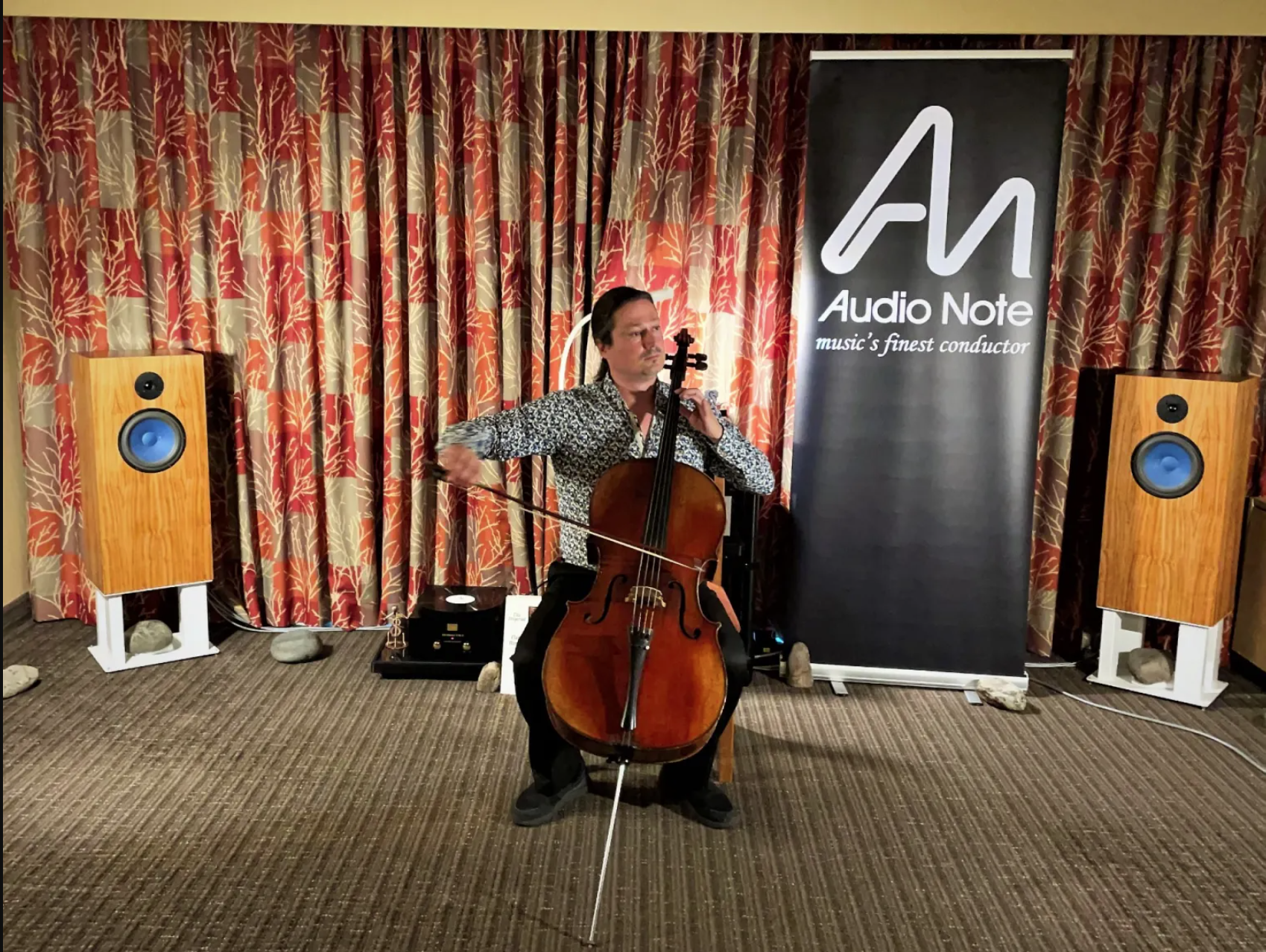
The AN/E SPe with high efficiency hemp drivers, in olive wood veneer cabinets


Oto Phono SE Signature integrated amp


CD 4.1x player

RMAF 2011 - Our Room

Tuesday, October 18th, 2011 by Mike

Unfortunately, our room never did get to where we wanted it this year. It wasn’t because a piece or two of equipment was brand new or anything, it was because we just didn’t get it setup optimally in the 4-days we were adjusting and adjusting and adjusting it.


Neli early afternoon Sunday, the last day of the show

AN/E SEC Signature speakers
Kegon Balanced monoblock amps
M9 Phono preamplifier
Fifth Element DAC and Fifth Force power supply
CDT-5 transport
SOTTO and PALLAS cabling
Sogon power cords

When we picked the room, we were fully intending on showing a system like last year: The new Marten Coltrane 2 speakers, The Audio Note Ongaku integrated amp, Nordost ODIN cables, and the Emm Labs XDS1 CD/SACD player.

But we had shown Marten 5 of the last 6 shows, Nordost 6 of the last 6, and Emm Labs also 5 of the last 6, I believe. Over the course of the year, we decided to show the Audio Note speakers instead (last time we showed them it was in our large suite that we used to have at these shows). Which soon became a 100% AN system. And, somehow, we [or at least I] thought that the room we had picked had real corners, so that the speakers would really work the way it is supposed to. Corners do not matter for the Marten speaker but they really do for the Audio Note [much more later]. I know we did discuss which rooms had corners and which had air conditioners and conduits in the corners - and for some reason I thought only rooms that faced the atrium had air conditioners and well, wishful thinking I guess.

Oh well.

Oh, and before I forget - the small rooms in the tower are better than the small rooms on floors 4 and 5. They appear to have more solid walls, to be slightly larger, and the carpet is thicker, the hallways wider and the carpet thicker out there as well. In other words, they are more isolated from external noises - aka other exhibit rooms - than the rooms on floors 4 and 5. So maybe next year, if we show again at RMAF, we will get a tower room.

Anyway the next 4 days became an object lesson about how small movements of a speaker affect the sound of AN speakers [usually we move the speakers AND adjust the cabling and power cords to get the sound to where we want, but we wanted to keep this a 100% Audio Note system. We all setup little goals in life and this was ours last week].

We set the speakers equidistant from the sweet spot and at 45 degree angles to the corners - such as they were - a foot or so behind the speakers - to optimize bass response and listened. It was a little hard and bright on some passages so we toed them in a few times ending at about a 1/2 inch more toed in and we got highres, emotional, tuneful music. The reason for the large toe-in is that Audio Note speakers are designed to sit right smack tight in the corners, horn-loading the corner and using the corner itself as part of the speaker to increase bass response and room engagement [and other frequencies as well, like a megaphone or cupping your hands in front of your mouth like a little horn to increase the SPL of your voice].

This was pretty much the setup the first day.

Problem was that, although there was lots of bass during passages that had bass, the overall presentation was somewhat lean. The midrange was not getting that ‘full’ sound that comes with having bass even when bass notes are not being played. We were just too far from the corners.

So that night [or the morning the next day - hard to remember, except that we did it when no people were there to see us huffing and puffing with these little speakers :-) ], we tried moving one speaker, the left side, which was about an inch or two from the sidewall, to sit directly against the wall - to get a fuller sound.

Hmmm…. now the left side was noticeably louder than the right - not just in the bass, but just about all frequencies were louder. The corner it was sitting in was a less deformed corner than the right side’s corner.

So we decide to bring them forward some to get them away from the corners so that the left side would see a corner more like the right side, so both sides would have somewhat similar freq responses to each other. And somewhere in here Neli mentions that Peter Qvortrup, of Audio Note, had suggested we move the speakers forward some. You know, sometimes spouses are the slightest bit annoying. So we go back and forth about how much to move them forward, and Neli decides from one boldish yellowish strip to the next, or about 4 inches [everything on these carpets is easy aligned by watching where the stripes are. VERY convenient]. Me, I do not care how much forward we move them, I think we just need to move them and see if it gets better or worse and in what manner it does this.

After the move it sounds like the SPL have actually increased [even though it is further from the corner], and the speakers are back to performing their usual disappearing act.

But we still weren’t getting as much of that ‘full sound’ as we were hoping for.

Now for a slight digression.

Something has to go between the speakers and the speaker stand. We often use HRS Nimbus Couplers, flexible custom polymer ‘cookies’ that are made to channel vibrations between 2 solid objects. This allows us to 1) easily adjust the orientation of the speaker [a towel between speaker and stand works wonders here too] and 2) optimize the amount of observed resolution at the listening positions. Both Audio Note and HRS do not really recommend this [AN thinks it is detrimental and HRS thinks it is unpredictable - depending on the speaker design characteristics]. But hey, at least some of us Americans are still bad at following rules and like to think for ourselves, experimenting with all sorts of stuff [and not just the economy :-) ] to see just what happens.

So, kind of in that spirit, and because we were kind of desperate, we decided to try following the recommended procedure in this case and use Blu Tak [kind of like blue Silly Putty, or clay] between the speaker and speaker stand.

Definitely different.

Essentially more dynamic, more immediacy and more PRaT. More exciting.

There was also, as expected, less resolution [Peter Qvortrup thinks there is just less energy in that region of the frequency band, that the frequency response is now more flat, more linear, more accurate.] Maybe PQ is right, but we like our resolution, helps prevent a hardness in the sound - especially during notes like an opera singer belting out a high note, or a guitar player smacking a high note - very high resolution helps break up those notes from being a solid hammer on the ear drum to become multiple shades of harmonics that the ear can process comfortably, in fact even pleasurably :-)

OK. So we put HRS Nimbus under the preamp and DAC power supplies [we did not have enough on the first day to do this] and we adjust the speakers toe in again and again - trying to get the resolution as high as possible. We KNOW it is there right? We know it is getting to the speakers and we know the speakers can reproduce it. We are still orienting the speakers around the 45 degree angle, pointing somewhat directly away from the corners of the room, such as they are. We are only partially successful at this but overall the sound is better after these changes and we leave it in this configuration on Saturday and most of Sunday.

Well, Sunday was slow. Sunday mornings are always slow. And it doesn’t get that much better later, peaking around noon or 1 pm (the show closes at 4pm). Not so much because of people going to church but because of Football [esp. if the Broncos are playing] . At least, that’s what I think, living here outside Denver for several decades now.

So, eventually, we get bored.

Earlier Sunday morning Neli and Peter were having coffee and I was watching them drink it [I’m not a coffee drinker, though I love the aroma] and we were all talking and he sketched out a diagram showing how orienting the speakers differently can take advantage of the 1st reflections off of the side walls to augment the perceived SPL of the midrange frequencies. [we have not seen this in the manual or on the websites, and will write this up in a different post so it is more easily Googleable]. The basic idea is that if the sound from the 1st points of reflection arrive no later than 2.7ms (or 3.2ms - not sure here) then the ear will not be able to detect a difference between the two. In this way the speaker will appear to be more powerful than it really is.

Cool huh?

So I manhandle the speakers on the Blu Tak, without moving the speaker stands, so that they no longer cross in front of the sweet spot and in fact look like more normal positions. The 4 corners of the speakers are kind of hanging off the stands and I am not sure all the blutak is in place - but we only have an hour or two left to the show and visitors come in and leave quickly, not really listening, as they approach warp speed trying to see everything they did not get to in the previous 2.5 days.

I hadn’t talked to Neli about this first, and was hunkered down for the possible sh*t storm for seriously mucking with things in the middle of a show day - but she was apparently preoccupied with those business-like tasks that make it so we can eat next week - because I am still alive to tell the tale and able to write this report … :-)

After this adjustment of the speaker orientation, the midrange frequencies were indeed boosted some, the SPLs increased yet again, and we did get an increase in resolution. The sweet spot no longer worked, however, being now either too close to the front of the room or something because the speakers no longer disappeared from that position. ‘Course the speakers were not exactly symmetrical :-) and, whatever, the show was over and we were tired and it was time to go home.

——————–

Every room is different, but I personally like to have a number of arrows in my quiver that have some kind of predictable behavior, so that if we run in a problem, say X, we know that we can try A, B and C to try to ameliorate the problem.

Not only that but I like to understand in what circumstances the darn arrows work, and do not work, to the point of being able to describe them to other people [do you know how RARE this is? to actually understand something well enough to describe it? Schools these days just teach people by rote, to follow little rules blindly]. And, finally, to document them, so that other people can use them too. Can’t but imagine this would be useful to other people besides us.

To that end we will try and setup a Toolbox category here on the blog, or on the website, where we document how to go from sound point A to sound point B [there will no doubt be many ways, some expensive, some free (yes, you might want to try the free ones first)] and not just with respect to Audio Note and Audio Note speakers, but cabling and vibration control and all the rest.

RMAF 2011 - Setup is tomorrow

Wednesday, October 12th, 2011 by Mike

Neli drove some of our stuff down today. A couple of more trips tomorrow and we’ll be ready for Friday, Saturday and Sunday.

This year we are showing a 100% Audio Note level 5 system on HRS platforms and rack. This is the first time we have shown 100% Audio Note systems in both our room and the Audio Note room - but as we try and change things a little each year we thought this would be fun.

This will consist of:

AN/E SEC Signature speakers
Kegon Balanced monoblock amps
M9 Phono preamplifier
Fifth Element DAC and Fifth Force power supply
CDT-5 transport
SOTTO and PALLAS cabling
Sogon power cords

Peter Qvortrup - Audio Note founder and CEO will also be in attendance.

At this time I am planning on doing an ‘abbreviated’ show report, like last year.

Interesting things pre-show? It looks like Cessaro and GOTO and maybe Silbatone will have some interesting horn speakers for us to listen to.

Here’s hoping for some good drug-like sound at the show - I can really use it. I bet all of us could. :-) On the other hand, we’ve been getting good druggy sound here and it makes me not want to post on the blog or read the trade rags and visit the forums… or go to shows - been a very quiet summer… :-) Maybe some drug-like sounds are a little too relaxing? Nahhhhh….

(Jinro, Tenor, Lamm, solid-state) Amps for Kharma mid-size speakers for mid-size rooms

Saturday, April 2nd, 2011 by Mike

[We often get questions sent to us by email. Often the answers take a good deal of time to write - and after we respond we hardly ever hear back from the questioner. So, although we have talked about doing this for quite awhile this is the first time that, when the answers seem to be useful to a wider range of people, we will start posting them here. We will keep the questioner anonymous unless requested otherwise.

I originally wrote this presuming the person was not in the U.S….]

—————————————–
THE QUESTION

Dear Mike and Neli

Reading your web site and audiogon we have very similar taste in music systems. Please let me know your thoughts that will help me with my next system. I have to ask you because

I won’t have a chance to listen to all combinations. I currently have Edolon (older) and CAT JL2. But there was always more music coming from my friend’s Kharma3.2/Tenor 75w OTL.

I think of moving towards Kharma speakers. Not quite sure which system to end up with. I consider following

1. Kharma Mini/Lamm ML2.1
2. Kharma Mini/ Tenor 75W OTL
3. Kharma Midi/ Tenor 300 hybrids
4. Kharma Midi/ MBL 9008 monos

I don’t have enough funds to go for Audio Note Ongaku amps

I really loved Tenor 75W OTL but didn’t have a chance to hear Lamm ML2.1.

Most people who heard both ML2.1 and 75w OTL leaning towards Tenors OTL. Jtinn and Mike Larvin preferred Kharma Midi/Tenor 300 hybrids. Also Tenor support was questionable for these older Tenor models and, on other hand, Lamm support was fantastic.

I will have medium size room, so both Midi and mini will do fine there.

Please let me know what would you choose in my situation?
————————————————–
THE ANSWER

I imagine that your current system sounds a little too laid back, especially at various frequencies? Much as I love the Avalon speakers, I have not yet heard an amp on them [so far!] that makes have that drug-like sound [would love to try the Ongaku someday :-) ]

The Kharma 3.2/Tenor 75w is a VERY magical combination - especially w/r to midi and micro-dynamics - missing only some slight harmonic color and, of course, some of the authority and fill that a larger speaker usually has. This is a classic system. A direct upgrade is indeed perhaps the Tenor 75w on the Midi - which we have heard but as you might expect there will be some ultimate SPL limitations [and may tax the 75w to the point that it blows up more often, more often than not taking a few speaker drivers with it when it does, as the 75w’s are wont to do].

Which begs the question: what is a ‘medium-sized room’? How loud do you listen? How important is rock-solid bass at high SPLs? Why are you not just getting a 3.2/75w and putting an awesome front end on it with the left over $$$? How would you improve your friend’s system sonically [louder? more neutral? more bass? …]

OK. On to the amps…

* The ML2.1 did not drive the Mini to our satisfaction in a 15×28 foot room [5 x 9 meters] unless you are going for very intimate nearfield midrange nirvana - the speaker may be harder to drive than the Midi, and is definitely harder than the 3.2

* The Tenor 300 hybrids did not have much [any?] of the magic that the 75w OTL did

* The new Tenor hybrid are $$$ and an Ongaku is probably cheaper and definitely makes more music unless you are looking for big, BIG SPLs

* The MBL… Kharma actually does not sound bad with solidstate amps. It will not be like your friend’s system - the sound will be bigger, more room pressurizing [if you know what I mean], more authoritative. But less intimate, less PRaT, less musical, less mini- and micro-dynamics etc…

The Lamm hybrids should be mentioned, they will be a powerful denser harmonic sound - but this may be too much like your current system, albeit a good deal more lively [but just not as lively as the Tenor OTL on the 3.2].

I would pick an Ongaku or Lamm ML3 :-) if I were you and you had the funds. Well, I am of the firm belief that we all have to always be well prepared for the non-zero probability that funds might start falling out of the sky in our general direction. :-)

You might also consider the Audio Note U.K. Jinro ($22K USD or so. It is a copper version of the Ongaku, which uses silver) which will drive the speakers fine - with less resolution [both w/r to detail and harmonics] than the almighty Ongaku but good midi- and micro-dynamics fairly close - but not quite - to the Tenor 75w. And it won’t blow up and is an integrated. This is probably your best choice for a sound similar to your friends but bigger and I might almost say better in every way [I could say ‘better’ with confidence if you milked all the dynamics possible using HRS vibration control, and the right cables and power cords and sources. Especially with the Mini Exquisites which are just oozing harmonic and inner detail]

In the end, on a budget, I would choose the Jinro or the solidstate solution [not just MBL, but Edge, Vitus etc. We made a list on the blog of the better solidstate out there… an older link is HERE] and then tune the living daylights out of the signal you are giving them [i.e. cables and power cords and rackage].

Oh! the Wilsons… The ML2.1 on the Watt Puppies…. Let’s just throw in the Sophia and Sasha in this discussion too. And the Marten Coltane too [I am presuming you are looking mostly at the used market given your selection of possible amps, half of which are no longer being made]. You will have some ultimate SPL issues here too which I do not know will be a problem for you are not. I like these Lamm combinations a lot - although it is a ‘different musical’ than the Kharma/Tenor. It is more stately and sensual as opposed to exuberant and exciting. I think of these as comparing a wife to a girl friend. Both have their good points. [I, personally, did not mean that last sentence to apply to myself, Neli :-O :-) ].

——————————————
Hope people find this kind of Q&A interesting…

Audio Note CDT-5 transport and Fifth Element DAC observations

Sunday, March 13th, 2011 by Mike

This $185K (2011 pricing), 3-box (CDT-Five Transport, Fifth Element DAC and its Fifth Force power supply) digital front end is somewhat difficult to describe and put into context except to say that it is so clearly better in so many. many ways than what has been previously available - it is hard to imagine even those audiophiles with preferences out there on the very fringe not easily, EASILY preferring this player over other players and most turntables.

But, OK. Some details…

It is expensive. OK. Got that out of the way. :-)

It is also unquestionably significantly better than other playback, and by so a large a margin, that it is easy for one to fall into this “Why would I ever want to play anything else?” attitude and just stop thinking about what it is doing. You stop thinking in terms of “Oh, I wish we had an LP version of this CD” and start focusing on the music [and finding out where it has hidden itself in your collection if your collection is as unorganized as ours is :-) ]

This playback is better in all the areas, if we are going to slice and dice it, that audiophiles might feel are important: if you are a detail head, this playback has so much more resolution that it restores your faith in science [more on this later]. If you are a harmonics-head, … oh boy. If you are a sound-stage head, or imaging-head, or dynamics head [later, later]… everybody who focuses on their must-have attributes - they will be ecstatic because they are all there to the max, glorious in all their splendiferousness.

[later] This may be hard to explain to people who are not familiar with what LPs do so well compared to CDs… but let’s try. CDs are supposed to have a larger dynamic range than LPs, but this seemed true only when one compared the softest possible note that these media can manage with their loudest possible note. But with ordinary notes, CDs have always sounded compressed. Dull. Not as lively as an LP. I have always thought ‘more dynamic range’ was essentially marketing BS. But… with the CDT-5/Fifth Element, the difference in dynamics between CD and good LP playback is so small, I do not know now which has more dynamics [it is close enough, I am not sure I care all that much to see which ‘wins by a nose’ here].


(the Fifth Element DAC. The metal appears slightly red because the nearby sunlight is reflecting off our bright red leather couch)

Let’s compare this stack to the Emm Labs XDS1. No we are not eating our young here, we love love love the XDS1, but I think it might help to compare the Audio Note to this very different sounding player that we have so much respect for here at Audio Federation. Although the XDS1 is only $25K (i.e. one EIGHTH the price) it is significantly better than all other solid-state players no matter their price and no matter your sonic preferences [Of course, the same can be said for their little $11,500 CDSA player as well, but let’s not go there…].

It might be instructive to revisit the ways in which the XDS1 excels as a CD/SACD player. First, it has an amazing ability to render the various threads in a musical score without jumbling them all up - not just great separation of notes, but of separation of sequences of notes, various harmonics and of the instruments themselves.

Second it has an extremely black black background. When a note decays you can hear it… hear it… still hearing it… until it ends or the recording engineer turns the volume down to zero. This also allow us to hear very very fine subtle notes and note characteristics. This might be considered another side to ‘high resolution’ - allowing us to actually hear the resolution that is there as opposed to artificially shining a light on the note attacks in various regions of the midrange as is so common amongst the competition.

Finally [skipping to the end here…] the XDS1 just sounds less digital and more like music. I always find this amazing, when comparing this player in shootouts. The other players do not ’sound digital’ until one hears the XDS1… and then it is “OMG, how did I not hear this problem before?”

OK.

Back to Audio Note’s Fifth Element DAC and CDT-5 Transport.

This is a tube-based solution and therefore you might think it has its natural advantages and disadvantages.

BZZZZZZZZZZzzzzzzzzzt! Wrong.

Well. You are right but…

…just not as right as you think you are ;-)

The Audio Note digital source really excels in the areas where solid-state usually reigns supreme [love that word], it has higher resolution, better separation and Alllllmost as black a background in our shootouts [and, uh, maybe even a blacker background than the XDS1 - note-to-self we really have to move around some power cords to make this a little more fair].

In other areas it has [very very close!] the midi-dynamics of a good LP playback, it has a tonal truth that I have not heard ANYWHERE else [enough to make you cry when you realize just how poor our usual playback harmonics have been in this regard for the last 100 years]…. You can just add lots of etc.s here - but these are just some of the characteristics, the punching-me-in-the-face differences, of this digital solution compared with all others.

So…

It is 8 times as expensive as the XDS1… and 99% of all other players [many of which really, really suck - why do people buy this stuff? ]…

Is it 8 times as good?

It is this question, me trying to figure out what “8 times as good” means, that has taken me all these many weeks to understand [I could have written the above review in the first 10 minutes or so of hearing the Fifth Element/CDT-5].

One could approach this in this manner: The Fifth Element/CDT-5 is to the XDS1 as the XDS1 is to the…. well, I am not all that familiar with $3125 CD players. One could look at a used Audio Aero Capitole [$4K? a steal] or used Emm Labs CDSA [$5500K how do other solid-state CD player manufacturers stay in business…] or …

So, yeah. 8 times better.

One could also approach this as in “Where is the best place for me to spend $200K in my system?”

:-)

Well, it depends on your system and budget… and really, if you play CDs and want your CDs to sound their best and you just want to KNOW they sound their best and you don’t want to waste your life not listening to the best [which pretty much DOES describe myself, when I have the funds… (oh, and Neli? *sheesh*, she is more gung ho than me half the time)]


(the CD is IsoMike’s release of the Fry Street Quartet playing Haydn)

For the first time since Audio Federation started I started bringing out old OLD CDs. Old Cocteau Twins. Old Patrick O’Hearn, Old Pink Floyd live concert bootlegs [you never seen 3 people more hypnotized by the music - ever have a hard time blinking? - as we listened to an old version of Echos. Magic? Drug-like? How about Warp Drive-like]. Old Jefferson Airplane…

Let’s use Surrealistic Pillow as an example. A gold CD from 1985 or so. Sounds horrible. Seriously, seriously mucked up, man. Especially the complicated electric guitar sections - bright, confused, over-saturated, noisy, you name it. On the CDT-5/Fifth Element you could hear exactly how bad it is - but it wasn’t painful and there wasn’t any problem with listening to the whole CD. This digital playback is really good at stitching together the stuff it finds on CDs and making notes and stringing them together into music. This makes it sound nothing like a ‘digital sound’ with good CDs and makes bad CDs also not sound like digital, but instead like just good, but very badly recorded, music.

Typically, bad CDs are very painful to listen to because their badness, often very aggressive digital-sounding notes, is too hard for most players to handle - and those that can handle it, it is because they just dull and smooth the notes down to round blobs… which of course they also do to all kinds of music played, good or bad. But the CDT-5/Fifth Element does not sacrifice resolution or detail - instead one might say it is the over abundance of resolution, and perhaps especially harmonic resolution, that allows us to have our cake and eat it too i..e very well recorded music has all the detail you will ever be able to hear and bad music is actually listenable and to some extent enjoyable [limited in this case by our knowledge that we should be able to find a better recording of this if we could just get our lazy butts off of the couch :-) ]

OK. Kind of a longish review. I won’t bore people with the “equipment has to go back, hate to see it leave, wish we could afford it” end-of-review cliche.

Instead, I will mention a way we use to make us psychologically come to terms with this eventually having to go back to the continent [it is AN’s show digital]. We could just not play music for a couple of weeks - and let the memory dim. We could throw a tantrum and stomp our feet [Oh, I so much want to do THIS!]. We could close Audio Federation, sell a lot of demo stuff off the floor, and just order them up.

But, another perspective is… we now know what the best digital is. No question. And there is nobody else really trying to make the best digital [though they are good at making the most EXPENSIVE this or that out there, and, with the press, the most hyped]. So we put it on The List, we look at the budget, and when we can afford it we will get it back. The hardest part - the analysis and getting to the actual buying decision, is done. And meanwhile we can enjoy other digital, hearing some issues they may have but that is OK. The CDT-5 transport, Fifth Element DAC and Fifth Force power supply are on our (capital ‘L’) List, don’t you know?…

i.e. …They’ll Be Back.

[thanks Jim, I think I stole this perspective from you(?)]

Audio Note Factory Tour

Tuesday, February 1st, 2011 by Mike

A nice overview of the Audio Note factory by a local dealer in the U.K. [thanks, Florian!]

DecoAudio: Audio Note Factory Visit December 2010

We have also had occasion to see inside the Fifth Element [we (me) somehow put it upside down in the car on the way back from CES and wanted to make sure the tubes had not jiggled loose. The tubes were just as solid as if I had put the DAC in the car right-side up]. Very impressive. Yes, I took photos and we’ll post them sometime in the near future.

CES 2011 - Audio Note

Sunday, January 16th, 2011 by Mike


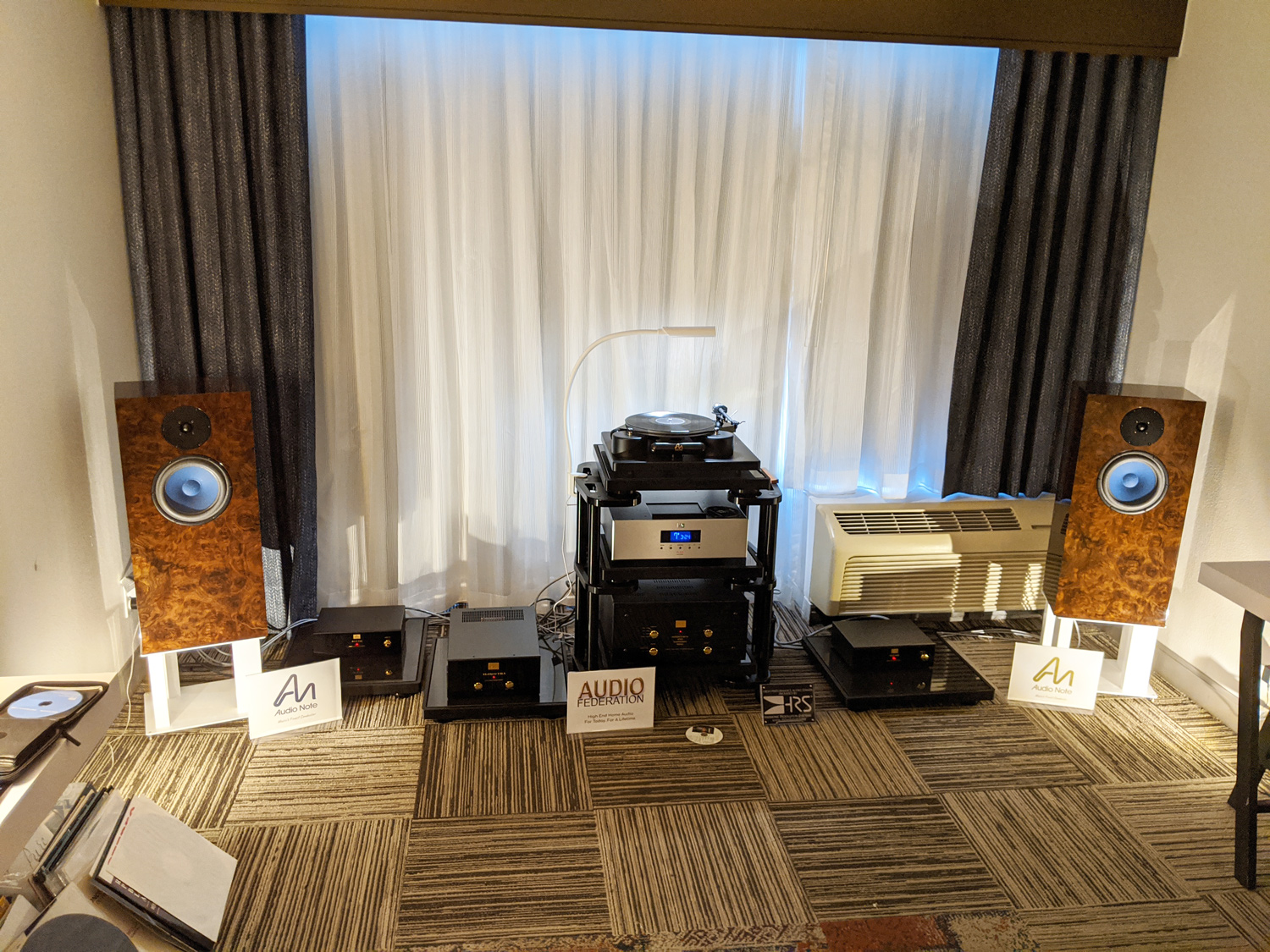
Our setup this year. More photos forthcoming.

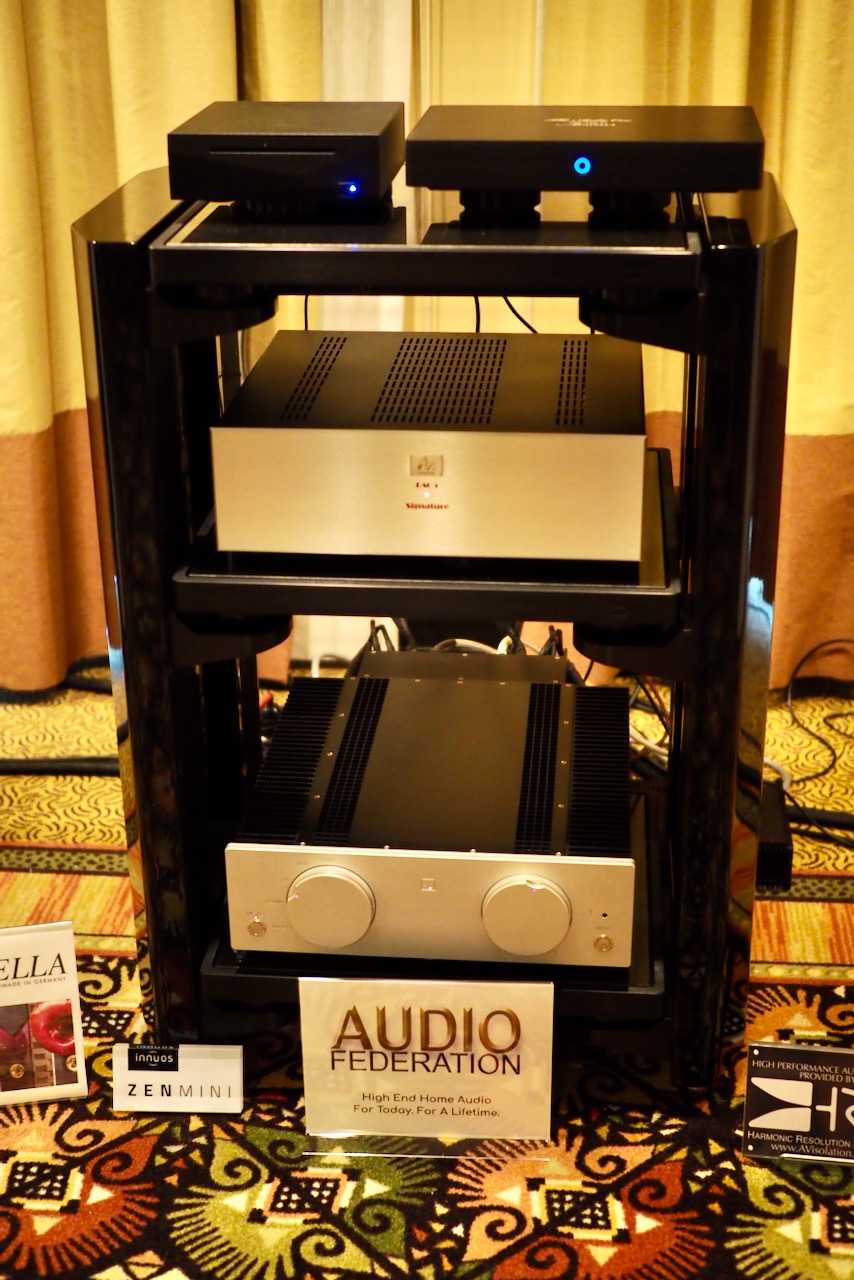
The Audio Note CDT-Five transport, Fifth Element DAC and Fifth Force power supply were running into the Audio Note Ongaku integrated amplifier. Much more about this digital in previous posts and expect a whole lot more in future posts.

It is hard for me to talk about these in the context of this room because of all the previous systems I have now heard this digital in. For example, we had a shootout between this and the (older version of the approximately $22K) Audio Note DAC 4 Balanced and CDT-3 transport. This pair of ours has over the last several years has beat all tubed digital solutions we have heard and is especially talented in the area of Harmonically Rich Musicality with Resolution category. But the CDT-5 and Fifth Element made it sound like it was producing clumsy, tonally naive square waves [seriously, it was embarrassing]. The amount of resolution this level 5 digital puts out is so phenomenal that it doesn’t sound like resolution at all anymore. What this means in terms of harmonic wealth and first-love-like involvement all follows from this resolution [I think. At least right now I think this.].

Was all this evident in the room at the Flamingo? Kind of. But it didn’t whack you upside the head [although some of the visitors to our room would disagree :-) ]. Maybe it shouldn’t whack a person upside the head. Maybe it should just grow on you over the hours and days of listening until you are spoiled for the rest of your natural life [like us. We are SO screwed]. As an exhibitor, however… I *do* indeed want the system to forcibly insert itself into each visitor’s pantheon of best moments in their life. And every person who does not leave shaking their heads and bumping into walls is something we take personally ;-)


The Audio Note TT2 Deluxe turntable with newer, better, good looking plinth. Also a new, very nice sounding and substantial Audio Note tonearm that is a drop in replacement for the standard Rega RB250 and RB300 tonearms.


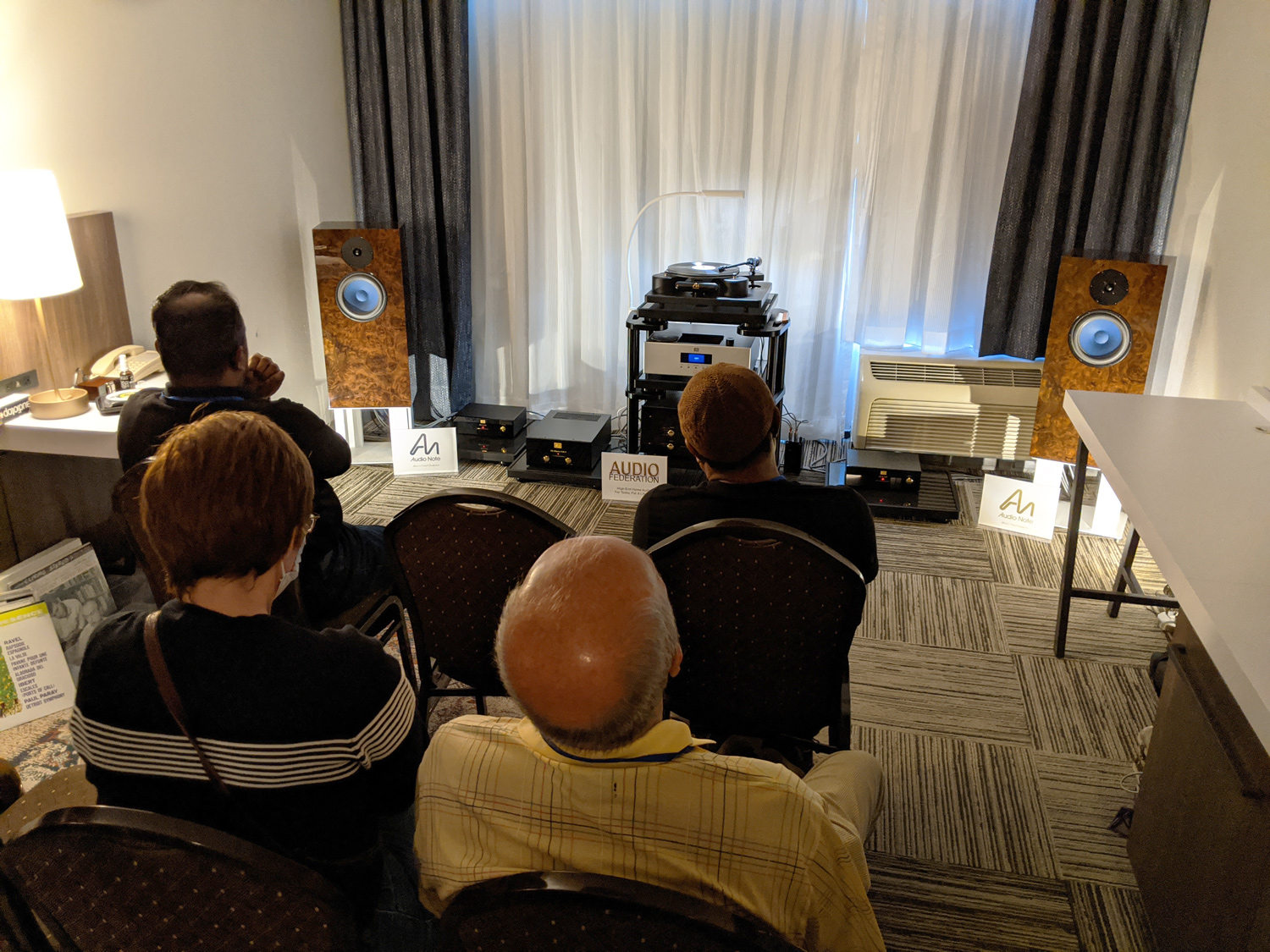
The Martin Grennall from Audio Note is DJ’ing for the room from his eclectic CD collection which Tom is holding on his lap. John Geisen, Audio Note dealer in Florida, is giving us a big smile up front. Dave Cope of Audio Note is referring to his laptop, and Andy Whittle of Audio Note is smiling at us from the corner seat.

Room setup in Las Vegas, CES 2011

Wednesday, January 5th, 2011 by Mike

Blue sky most of the way here yesterday. Nice.

Just a test photo…. of the Audio Note room during setup. Not sure it will look anything like this by the time the show opens… but I need to put the laptop thru its paces to make sure it all works for the show report.

Audio Note CES 2011 Room Setup

Mostly having issues with the Flamingo internet connections going up and down and up and down all of the time.

Audio Note CDT-5 transport and Fifth Element DAC downstairs

Monday, December 20th, 2010 by Mike


We moved the Audio Note Fifth Element, Fifth Force and CDT-Five downstairs to prepare for demos for a few out-of-town guests this week.


We have the CDT-Five next to the Walker, the Fifth Element DAC and the Fifth Force on the shelf below. The Walker is hooked up to the S9 step-up and it is all going to the M9 Phono preamplifier the two boxes there on the bottom left. Above them our CDT-Three and DAC 4 Balanced are also hooked up. Welcome to high-end audio shootout heaven.


We are still using the Jinro downstairs, soon to be the Ongako, as we move things around like mad during the demos. Our high-gain Kegon amps are on the left there on the old RixRax amp stands.


Closeup of the Audio Note Jinro integrated in black.

A few more details about the Fifth Element DAC (and its Fifth Force power supply):

* The Fifth Force is a separate power supply, which is an upgraded DAC5 Signature supply but with better stabilization, better mains transformers (double HiB c-cores) and other detail improvements

* Fifth Element Valve input buffer; the buffer is synchronized to match the output of the CDT Five, so whilst other CD transports will work, they will not be close to the performance of a CDT Five. The valve buffer consists of an EF800 Telefunken or similar, it has its own separate power supply with a 6X5 valve rectifier feeding the HT

* The I/V interface is a newly designed all silver wired transformer with a massive core (same as the AN-S9), it provides far better low level and is individually adjusted for the exact behavior of the output of the selected AD1865 converter chip


Presented by
Audio Federation

Old Audio Federation Website

email: mike&neli@audiofederation.com
Copyright (c) Audio Federation, Inc.
303-546-6503

The names of all brands of equipment are copyright and/or trademark their respective companies

Entries (RSS) and Comments (RSS).